
Morocco Desert Tours from Fes: A Complete Guide to the Sahara
Introduction
Few countries let you wake inside a medieval walled city and fall asleep three nights later on a silent dune beneath the Milky Way. Morocco does exactly that, and Morocco desert tours from Fes remain the most rewarding way to experience the contrast. Fes is the spiritual and intellectual heart of the country, a maze of narrow alleys where craftsmen still work brass and leather by hand, and where a thousand-year-old university sits quietly behind an unmarked door. From the moment you leave its gates and head south, however, the landscape begins to change, and it keeps changing until the road simply ends at the foot of the Erg Chebbi dunes.
That transformation is the real story behind every Fes desert tour. In a single journey you cross cedar forests where wild monkeys wait on the roadside, high plateaus where snow lingers into spring, palm-filled canyons carved by ancient rivers, and finally the open Sahara. At Morocco Lovely Tours, one of the best Morocco tour companies working directly on the ground, we have spent years refining these routes so that the driving never feels like driving. This guide covers the routes, durations, prices, seasons and honest practical details you need to plan the trip properly.
Why Start Your Morocco Desert Tour in Fes
Most first-time visitors assume Marrakech is the only gateway to the Sahara. Starting from Fes, however, offers real advantages that experienced travellers quickly discover. The route to Merzouga is shorter and considerably more varied, passing the Middle Atlas Mountains, the Ziz Valley and a chain of oasis towns that few tourists ever see. Moreover, you follow the old caravan corridor that once carried gold, salt and manuscripts north from Timbuktu, so the desert feels earned rather than simply visited.
There is a practical argument too. Because beginning in Fes and ending in Marrakech means you never retrace your steps, you effectively see twice the country in the same number of days. In addition, flights into Fes are often cheaper than into Marrakech, and the city itself is calmer, less commercial and easier to explore on foot than its southern rival. For anyone arriving from Spain, Tangier or Chefchaouen, therefore, desert tours from Fes create the most logical Morocco trip itinerary available.
The Route to Merzouga, Explained
The classic drive from Fes to Merzouga covers roughly 500 kilometres and takes eight to ten hours spread across a full day with regular stops. First you climb into the Middle Atlas and reach Ifrane, nicknamed the Switzerland of Morocco for its alpine chalets, tiled roofs and cool mountain air at 1,650 metres. It is one of the very few places in Africa where you can reliably see snow, and it makes the natural first coffee stop of the trip.
Next comes Azrou and the great cedar forest, home to some of the oldest Atlas cedars in the world and to troops of Barbary macaques that gather near the roadside. After the forest, the landscape opens onto the high plateau around Midelt, an apple-growing town wedged between two mountain ranges and the traditional lunch stop. In the afternoon you cross the Tizi n’Talghomt pass and descend into the Ziz Valley, where hundreds of thousands of date palms cut a green ribbon through bare red rock. Finally, the last stretch runs through Errachidia, Erfoud and Rissani before the dunes of Erg Chebbi rise on the horizon like a wall of orange silk.
Fes to Merzouga Round-Trip Tours
Our Fes to Merzouga desert tours travel south through the Atlas and then return you to Fes at the end, which suits travellers flying in and out of the same airport or continuing north to Chefchaouen afterwards. Once you reach the Sahara, a camel ride of more than an hour carries you across the dunes to a Berber camp, where dinner is served under the open sky and drummers play late into the evening. In the morning you climb the nearest dune for sunrise, watch the sand shift from grey to pink to blazing orange, and then begin the journey home.
The two-day tour is the fastest option and still delivers the camel trek, the camp and the sunrise, although it involves a lot of road time relative to desert time. The three-day tour, by contrast, is the sweet spot: it adds the dramatic Todra Gorge and the ancient caravan town of Rissani while leaving room to enjoy Merzouga itself with a 4×4 excursion or a visit to a Gnawa music village. Longer four and five-day itineraries continue west instead of returning north, taking in the Dades Valley, Skoura Oasis, Ait Benhaddou and Ouarzazate before finishing in Marrakech.
Fes to Marrakech Desert Tours via Merzouga
Our Fes to Marrakech desert tours run from two to seven days and remain the most popular category we operate. The reason is simple: you would otherwise spend eight hours on a train between the two cities and see nothing at all. Instead, for a comparable outlay, you cross the Middle Atlas, the pre-Sahara, the desert, the oasis valleys and the High Atlas, sleeping in kasbahs and desert camps along the way.
The Fes to Marrakech desert tour 3 days is our best seller by a wide margin. It includes camel trekking in Erg Chebbi, a night in the dunes, the Todra Gorge, an overnight in the Dades or Skoura area, and the UNESCO-listed Ait Benhaddou Kasbah. Four and five-day versions add breathing room, short hikes and a night in a restored kasbah hotel, whereas six and seven-day routes include a second desert night, nomad encounters and villages that most itineraries drive straight past. The same corridor also works in reverse as a Marrakech to Fes desert tour 4 days for travellers flying into the south.
Longer Morocco Trip Packages
Many clients ultimately want more than the desert alone. Our 10 day Morocco tour therefore builds outward from the Sahara route to include Casablanca, Rabat, Meknes, Volubilis, Fes, Merzouga, the Dades Valley, Ait Benhaddou and Marrakech, often finishing on the Atlantic coast at Essaouira. A well-paced 10 days Morocco itinerary allows two nights in the major cities rather than one, which changes the experience entirely: you finally get a full day to explore instead of an afternoon squeezed between transfers.
For travellers with a fortnight, the 13 days Morocco tour adds Chefchaouen, the Rif Mountains, the Draa Valley and the Anti-Atlas. Because this route loops through every major region, it remains the most complete Morocco itinerary we operate. Whether you choose 10 days in Morocco or longer, though, the principle stays the same: fewer hotels, longer stays and far more time on the ground than in the vehicle.
Desert Tours from Other Moroccan Cities
Although Fes is our speciality, we also run desert tours from Casablanca, desert tours from Marrakech and desert tours from Tangier, so no arrival point excludes you from the Sahara. Casablanca desert tours typically last seven to ten days, since the city sits on the Atlantic and the journey naturally incorporates Rabat, Meknes and Fes before turning south. Tangier desert tours, meanwhile, begin in the north and usually feature Chefchaouen and the Rif, making them ideal for travellers arriving by ferry from Spain.
Marrakech desert tours are the shortest and most direct route to Merzouga or Zagora, crossing the High Atlas on day one and reaching the dunes by the second evening. Whichever gateway you choose, the desert itself remains identical: the same Erg Chebbi dunes, the same camel caravans, the same star-filled sky. Only the approach differs, which is precisely why comparing tour companies on route design matters far more than comparing them on price alone.
Highlights of Our Fes Desert Tours
Every itinerary differs slightly, yet a core set of experiences appears across almost all of them. Together they form a portrait of the country that no single city could ever provide, moving from imperial architecture to alpine forest, canyon, oasis and finally open desert within a handful of days.
- The UNESCO-listed Medina of Fes, with its souks, tanneries and mosaic madrasas
- Ifrane, the Switzerland of Morocco, and the ancient Azrou cedar forest
- The Ziz Valley, one of North Africa’s great palm oases
- A camel ride in Morocco across the Erg Chebbi dunes at sunset
- A night in a traditional desert camp with Berber drumming and tagine
- The Todra and Dades Gorges, with vertical cliffs and switchback roads
- Skoura Oasis and the Valley of a Thousand Kasbahs
- Ait Benhaddou, familiar from Gladiator and Game of Thrones
- Ouarzazate, the Gateway to the Sahara, and the Atlas Film Studios
- The High Atlas crossing via the Tizi n’Tichka pass at 2,260 metres
- Rissani, an ancient market town and birthplace of the Alaouite dynasty
- Marrakech, with Jemaa el-Fnaa, the Koutoubia and the endless souks
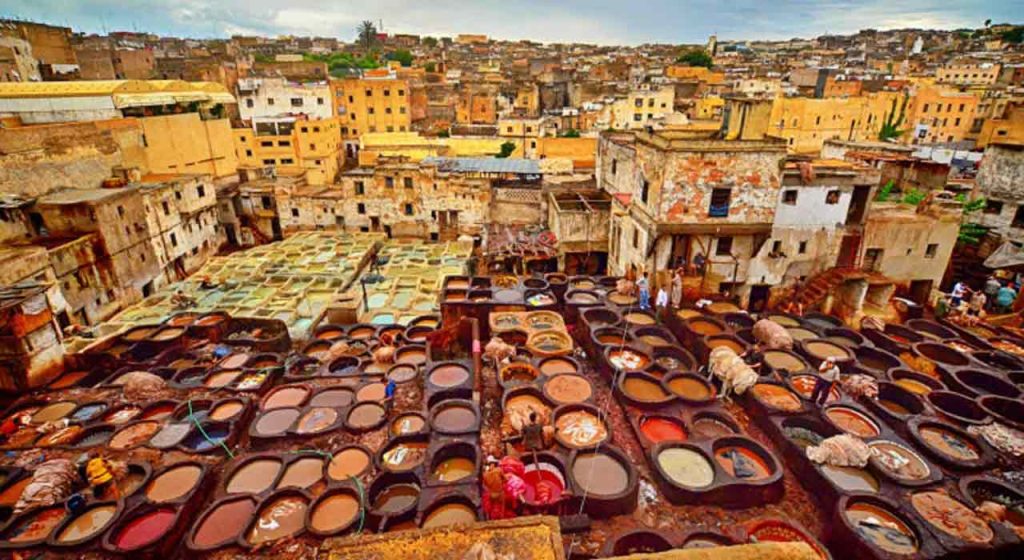
Crucially, each stop is more than a photograph. The tanneries of Fes still use methods described in fourteenth-century manuscripts, the kasbahs of Skoura remain family homes rather than museums, and the Gnawa musicians of Khamlia perform a living tradition rather than a staged show. Travelling with a knowledgeable local driver-guide is therefore what turns scenery into genuine understanding, and it is the single biggest difference between a good desert tour and a forgettable one.
Tour from Fes :
2-Day Sahara Desert Tour From Fes
2 Days Marrakech Tour From Fes
3 Days Morocco Desert Tour From Fes
3-day Desert Marrakech Tour From Fes
4-day Morocco Desert Tour From Fes
Shared Group Tours Morocco
Our shared group tours Morocco departures make the Sahara affordable on almost any budget, with prices typically starting from 180 euros per person depending on duration, season and inclusions. Every departure includes air-conditioned minibus transport, the camel trek across Erg Chebbi, an overnight stay in a Berber camp, traditional Moroccan meals and an experienced local guide who explains the culture and landscape you are crossing.
Most of our Morocco small group tours are built for genuinely small numbers rather than coachloads, which keeps the atmosphere personal and the logistics flexible. For many people, in fact, sharing a vehicle with travellers from six different countries is part of the appeal, since conversations that start over breakfast in Midelt often end with exchanged addresses on the dunes.
The trade-off with any shared tour, however, is control. Departure times are fixed, stops are standardised and the group necessarily moves at the group’s pace. If you are travelling with young children or want to photograph the blue hour rather than pack the vehicle at dawn, a private tour will serve you better. For independent travellers, backpackers, students and couples watching their budget, though, shared departures still deliver outstanding value. Booking ahead is strongly advised between March and May and again from September to November, when popular dates sell out weeks in advance.
Private Custom Fes Desert Tours
Our private Fes desert tours offer a more comfortable and flexible way to travel, largely because the itinerary is built entirely around you. You decide when to leave in the morning, how long to linger at each stop and where to eat lunch. If a village market catches your eye, the vehicle stops. You also travel in a modern private 4×4 or minivan with air conditioning, which genuinely transforms long driving days.

Just as importantly, you get a dedicated driver-guide who speaks English, French, Spanish and Arabic alongside Berber dialects. Our drivers are licensed professionals, most of them from the south, and they are not simply chauffeurs. They are the reason you end up drinking tea in a family home in the Dades Valley instead of eating at a roadside cafeteria.
Accommodation ranges from clean, simple guesthouses to restored kasbah hotels and luxury desert camps with en-suite bathrooms, real beds and hot showers. Importantly, a private tour does not automatically mean a luxury tour; it simply means the trip belongs to you. As an established Moroccan travel agency, we quote Moroccan holiday packages at several price points and let you choose, rather than pushing the most expensive option available.
Camel Trekking and Desert Camps
The camel trek is the emotional centre of every Fes Sahara desert tour, so it helps to know exactly how it works. You usually set out about ninety minutes before sunset, riding in a small caravan led on foot by a local guide, and the ride to camp lasts between forty-five and ninety minutes. Long trousers, closed shoes and a scarf for your head and neck make a real difference. If riding is not for you, or if you have back or hip problems, we can arrange a 4×4 transfer to the same camp at no loss of experience.
Camps generally fall into two categories. Standard Berber camps offer shared bathrooms, woven tents, mattresses and thick blankets, whereas luxury camps provide private en-suite tents, real beds, electricity, rugs and hot water. Both serve the same dinner of Moroccan salad, tagine or couscous and mint tea, and both include drumming around the fire afterwards.
What no camp can control, though, is the sky, and invariably it is what guests remember most. With no towns for many kilometres, the Sahara delivers one of the clearest night skies on earth, and on moonless nights the Milky Way is bright enough to cast faint light on the sand. Bring a warm layer even in summer, since temperatures drop sharply after dark, and set an alarm for sunrise. Climbing the dune behind camp before dawn is, without exaggeration, the best thing you will do all trip.
Best Time to Travel
Spring, from March to May, is the finest season for Morocco desert tours. Daytime temperatures sit between 22 and 32 degrees, the Middle Atlas turns green, wildflowers appear across the plateaus and the southern valleys fill with almond and rose blossom. Nights in the desert stay cool but pleasant, and the light remains soft enough for excellent photography.
Autumn, from September to early November, is equally rewarding and noticeably quieter. The summer heat has broken, the date harvest is underway in the Ziz and Draa valleys, and October in particular offers warm days and extraordinarily clear nights, which is why photographers and stargazers favour it.

Summer is challenging in the deep south, where Merzouga can exceed 45 degrees, so schedules shift to earlier starts, longer midday breaks and late camel treks. Winter, by contrast, is genuinely underrated: days remain mild and sunny at 18 to 22 degrees, the dunes are almost empty and the light is superb, although nights can approach freezing and Atlas passes occasionally close after snow. Come prepared with warm layers and you will effectively have the Sahara to yourself.
Practical Information and Packing
Pack light, since only a small overnight bag travels with you to the camp while the rest stays in the vehicle. Essentials include sunglasses, high-factor sunscreen, a hat or scarf, lip balm, closed walking shoes, a refillable water bottle, a headlamp and a power bank. Loose, breathable, modest clothing works best across Morocco, and carrying cash in small dirham notes is important because card payments remain unavailable across most of the south.
All tours use modern, insured, air-conditioned vehicles, and our drivers hold professional Moroccan tourist transport licences. The main roads are paved throughout, and the only off-road section is the short stretch of sand to the camps. Safety in the south is generally excellent, though standard travel sense applies and travel insurance covering medical care and cancellation is strongly recommended.
Food on the road is simpler and better than most travellers expect: bread, olive oil, honey and eggs for breakfast, tagine or Berber omelette for lunch, and a three-course dinner at camp. Vegetarian and vegan travellers are well served, since vegetable tagine, couscous and lentils are staples rather than special requests. Gluten-free is more difficult, so please tell us about allergies and dietary needs when booking and we will brief the hotels and camps in advance.
Responsible and Sustainable Travel
The Sahara is a fragile environment, and the communities living at its edge depend on tourism income that can disappear overnight. For that reason we work with locally owned camps, family-run guesthouses and Amazigh drivers and guides, keeping the value of your trip inside the region rather than exporting it to a distant head office. We also limit group sizes, avoid overcrowded camp locations and pay fair rates to the camel handlers and camp staff who make the experience possible.
You can help as well. Refill your water bottle instead of buying plastic ones, carry all rubbish out of the dunes, buy crafts directly from cooperatives and tip fairly. Small choices multiply quickly in a region where a single camp supports several families, so responsible travel here is not an abstract ideal but a practical necessity.
How to Book Your Morocco Trip Package
Booking is straightforward. Send us your travel dates, group size, preferred duration and whether you want a private or shared tour. We then reply with a detailed itinerary, a clear all-inclusive price and honest advice about what will realistically fit into your available days. There is no obligation and no pressure, and frankly we would rather tell you a two-day tour is too rushed than sell you one you will not enjoy.
Shared departures start from around 180 euros per person, whereas private tours are quoted per vehicle, so the per-person cost drops significantly as your group grows. Quotes normally include transport, fuel, a driver-guide, accommodation, breakfast, dinner at the camp and the camel trek. Lunches, entrance fees, city guides and tips are usually excluded and clearly listed. A deposit secures the date and the balance is paid on arrival.
Frequently Asked Questions
How many days do I need for a desert tour from Fes?
Three days is the practical minimum for a comfortable round trip, and three to four days is ideal if you finish in Marrakech. Two days is possible but involves long driving, while five to seven days delivers the richest experience.
How long is the drive from Fes to Merzouga?
Roughly 500 kilometres, or eight to ten hours with stops, spread across one full day. Fortunately, the route stays scenic almost the entire way.
Is the camel ride suitable for children or older travellers?
Yes, in most cases. Children from around six ride happily, often sharing with a parent, and every camel is led on foot. Anyone with mobility issues can transfer to camp by 4×4 instead.
What is the difference between standard and luxury desert camps?
Standard camps have shared bathrooms and traditional tents with mattresses, whereas luxury camps provide private en-suite tents, real beds, hot showers and electricity. Both include dinner, breakfast and evening music.
Are these tours good for solo travellers?
Absolutely. Shared Morocco small group tours suit solo travellers for both cost and company, and private tours are available for one person too, although the per-person price is naturally higher.
Do you organise families and student groups?
Yes. We regularly arrange Morocco family tours with child-friendly pacing and Morocco student tours with budget accommodation and flexible group pricing.
Can you arrange airport pick-up?
Certainly. All tours begin with pick-up from your accommodation in Fes, and airport transfers can be added at either end of the trip on request.
Conclusion
Ultimately, a Morocco desert tour from Fes is not really about the destination. It is about the transition, the slow unfolding of a country that changes character every hundred kilometres, from mosaic courtyards to cedar forests, canyon walls and finally an ocean of sand. By the time you reach Erg Chebbi you will have crossed four distinct worlds, and the silence of the dunes feels like the natural conclusion to all of them.
Whether you choose a three-day classic, a seven-day crossing to Marrakech or a full 10 days Morocco itinerary, Morocco Lovely Tours will build the trip around you, with local guides, comfortable vehicles, fair prices and the small human details that turn a holiday into a memory. Send us your dates today and let us design the Morocco trip itinerary you will still be talking about years from now.